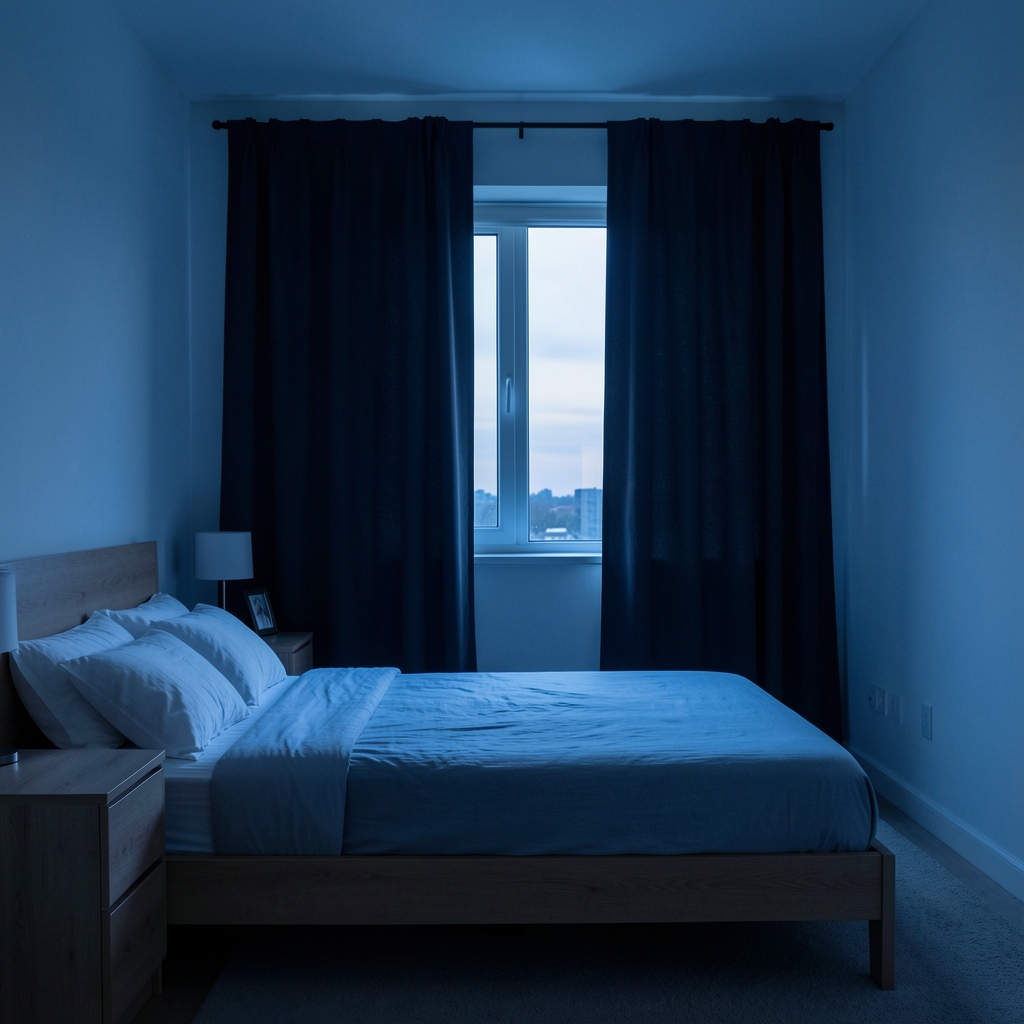
There is a period in the late evening — roughly the sixty minutes that precede the moment one lies down — that receives almost no dedicated attention in the general conversation about sleep. Most writing on the subject focuses on the quantity of rest, or on the environment in which it takes place, or on the biological rhythms that govern when the body is inclined to sleep at all. The hour immediately before midnight tends to be regarded as a prelude, a formality before the main event. The observations gathered here suggest it may be something more deliberate than that.
Contributors to this issue were asked to keep a written record of their pre-sleep hour for three consecutive weeks in the autumn of 2025. The records came back in various forms — some in the style of a ship's log, others more resembling pages torn from a personal notebook. What emerged was less a dataset than a collection of small, recurring patterns. Patterns that, when placed alongside the contributors' own assessments of their morning weight and energy levels, began to suggest a quiet relationship between how the evening ends and how the body accounts for itself overnight.
The Metabolic State at Rest
During the hours of sleep, the body does not switch off. It shifts registers. Processes that compete with one another during waking hours — appetite signalling, cellular repair, the consolidation of the day's inputs — proceed according to a schedule that is sensitive to the conditions under which sleep begins. The quality of that entry point appears to matter in ways that are not immediately obvious from a distance.
Contributor A, a writer based in South London, noted in her log that on evenings when she ate her final meal later than her usual nine o'clock hour, she consistently woke feeling what she described as "unresolved" — a word she used to mean both physically and mentally unsettled. This was not a dramatic observation. She recorded it quietly, without drawing conclusions. But when she cross-referenced it with the three weeks of entries, the pattern held across fourteen out of twenty-one evenings. Late final meal; less settled morning. The correlation was not perfect. But it was steady enough to be worth noting.
Contributor B, a man in his early forties who works in architecture, found the opposite variable most significant for him: the temperature of his room. On evenings when the window had been left open for at least an hour before bed, his sleep tracking journal recorded what he described as "cleaner" nights — longer periods without waking, less awareness of the night passing. His morning energy scores, which he rated on a simple one-to-five scale, averaged 3.8 on open-window evenings versus 2.9 on closed ones.
The Quiet Work of the Evening Wind-Down
What the contributors' logs share, more than any single variable, is an implicit argument for intentionality in the pre-sleep hour. Not urgency — none of them described elaborate rituals or the kind of maximised optimisation language that tends to characterise commercial wellness content. The word that appeared most often, across different contributors and different writing styles, was "quiet". A quiet hour. A quiet arrangement of the evening. A quiet transition.
This matters because it suggests that what the body responds to, in the hour before midnight, is not so much any specific action as it is the general quality of the transition. Whether that transition is managed by reducing light, or by putting the day's work aside, or by sitting without a screen for twenty minutes, the form seems less important than the fact of it. The body, by this reading, is looking for a signal. The signal is: the day is ending.
Light Exposure and the Body's Internal Clock
Several contributors noted independently that they had begun to reduce the brightness of their screens and overhead lights in the hour before bed, without any prior reading on the subject — it was simply something they had arrived at through attention to their own patterns. This convergence is interesting because it points toward a fairly well-documented principle in the published research on circadian rhythm: that the body's internal clock is sensitive to light in a way that has significant consequences for the onset and quality of rest.
The research broadly suggests that exposure to bright, blue-spectrum light in the hours before sleep suppresses the body's natural preparation for rest, pushing the internal clock later and reducing the depth of the sleep that eventually follows. The practical implication — reducing screen brightness or switching to warmer light sources in the evening — is something several contributors had independently adopted before encountering any formal account of it. Their logs recorded the effects in their own terms: easier to fall asleep, less fragmented rest, better mornings.
What is notable is not the principle itself, which is well-established, but the manner in which the contributors arrived at it. Through attention rather than instruction. Through keeping records of their own experience rather than following a programme. This is, in some ways, the central argument of the Gazette's approach to these subjects: that careful, unhurried self-observation is a more reliable guide than most prescriptive frameworks.
The Relationship to Overnight Weight Regulation
Weight is a long-term account, not a daily one. None of the contributors in this issue recorded dramatic shifts in body composition over three weeks. What several of them did record, and what is worth noting with appropriate care, is a relationship between the quality of their evening routine and their appetite patterns the following morning. On evenings that ended in what they described as a settled, quiet way, the following morning's appetite tended toward what they described as "calibrated" — neither suppressed nor urgently elevated. On evenings that ended in what they described as unsettled — late screens, late eating, difficulty winding down — the following morning tended to bring what one contributor called a "heavy hunger", a heightened appetite that felt less connected to genuine physical need.
This is an observation, not a conclusion. The relationship between sleep quality and appetite-regulating signals is a subject of active research, and the editors of this archive are careful not to overstate what a three-week contributor log can establish. But the pattern is interesting enough, and consistent enough across different contributors with different habits and different baselines, to warrant continued attention.
Keeping the Record
The practical recommendation that emerges from this issue is modest: keep a log. Not necessarily a structured one, and not necessarily for any particular purpose at the outset. Simply record, for a few weeks, what the evening looked like before bed, and what the morning felt like after. The relationship between the two, observed over time, tends to be more instructive than any general account of what the evidence recommends.
The contributors to this issue found their logs useful not because they revealed startling discoveries, but because they made visible what had previously been invisible: the quiet patterns that govern how a night goes, and how the morning that follows it begins. In that sense, the hour before midnight is not simply a prelude. It is a record of something — a small, daily act of setting the conditions for what comes next.
- The pre-sleep hour influences overnight rest quality in ways that compound over weeks.
- Contributors independently identified light reduction as a significant variable without prior instruction.
- Settled evening routines correlated with more calibrated morning appetite patterns across multiple contributors.
- Keeping a personal log for two to three weeks surfaces patterns that general advice cannot predict.