The body's internal clock does not run on intuition. It runs on cues. Chief among those cues, across the animal kingdom and in the human body specifically, is light. The presence or absence of light — and, more precisely, the quality of that light — is the primary signal the body uses to orient itself in time. When that signal is distorted in the final hours of the day, the downstream consequences extend well beyond the moment of falling asleep.
This entry draws on published circadian research and on contributor field notes gathered over the winter of 2025 to examine the relationship between evening light exposure and the depth and architecture of the rest that follows. The question being addressed is not simply whether bright screens delay sleep onset — that relationship is well-documented elsewhere. The question is what happens to the structure of overnight rest when that delay occurs, and whether those structural changes have any bearing on how the body manages weight and appetite over time.
What the Internal Clock Is Actually Measuring
The body's circadian system is oriented around a central oscillator in the brain, which receives information about the light environment through specialised cells in the retina. These cells are particularly sensitive to short-wavelength, blue-spectrum light — the kind that is common in daylight and, critically, in the light emitted by electronic screens. When blue-spectrum light falls on these cells in the evening, the circadian system interprets it as a signal that it is still daytime. The body's preparation for rest is accordingly slowed or suspended.
The practical effect is a delay in the onset of the internal clock's evening sequence: the lowering of core body temperature, the shift in energy allocation toward repair processes, the natural inclination toward drowsiness. When this sequence is delayed by an hour or two because of evening light exposure, the body does not simply stay awake longer. It remains in a daytime physiological state longer — with consequences for the depth of the rest that eventually follows and for the appetite and energy patterns of the next morning.
The Architecture of Rest
Sleep is not a uniform state. It progresses through a series of stages that cycle across the night, broadly divided into lighter and deeper phases, with periods of active dreaming distributed throughout. The deeper stages of this cycle — often referred to in the research literature as slow-wave rest — are associated with the most significant repair and consolidation processes. These stages tend to dominate the earlier part of the night, meaning that a delayed sleep onset does not simply shift all stages forward uniformly. It disproportionately compresses the slow-wave phases, which are the first to be sacrificed when the window available for rest is shortened from the front end.
This is the mechanism by which evening light exposure connects to rest quality in a way that goes beyond simple duration. A person who falls asleep at midnight rather than eleven o'clock may sleep for the same total number of hours, but the composition of those hours will differ. The proportion of slow-wave rest, arriving at a fixed biological point in the night's progression, will be smaller. The body's account of the night will show the same headline figure but a different internal structure.
Field Notes: Three Contributors, Eight Weeks
Three contributors were asked to track their evening light environment systematically across eight weeks, alternating fortnights of screen-free evenings with fortnights of normal screen use from seven in the evening onward. The records were qualitative rather than laboratory-grade, but the pattern that emerged was consistent enough to warrant inclusion here.
In screen-free fortnights, all three contributors reported an earlier onset of natural drowsiness — typically between thirty and sixty minutes earlier than their usual hour. Two of the three reported what they described as "deeper" or "more complete" rest, a subjective assessment but a persistent one. All three noted, independently, that their morning appetite on the day following a screen-free evening felt more predictable — calibrated, one contributor wrote, rather than reactive.
In normal-screen fortnights, two of the three reported difficulty falling asleep before their usual late hour even when they had intended to sleep earlier. One contributor noted that the nights following heavy screen use tended to feel "busier" — more awareness of the passage of time during the night, more frequent brief wakings. His morning energy ratings on those days were consistently lower, by a full point on his five-point scale, than on the days following screen-free evenings.
The Weighted Blanket Variable
One contributor introduced a weighted blanket during the second screen-free fortnight, without prior suggestion from the archive. The note she added to her log is worth recording directly: "The combination of the dimmer room and the heavier blanket seems to add up to something more than either would alone. The room feels like it is agreeing with my body about what time it is."
There is a small but growing body of published research on the effect of weighted blankets on rest quality, particularly for individuals who experience restless or fragmented sleep. The proposed mechanism involves the gentle pressure of the blanket triggering a calming response that appears to support the body's transition into deeper rest. Whether the effect compounds with reduced light exposure, as this contributor's observation suggests, is not yet well-established in the research literature, but it is a plausible hypothesis and one that several contributors to the Gazette have now independently arrived at.
Managing Light in Practice
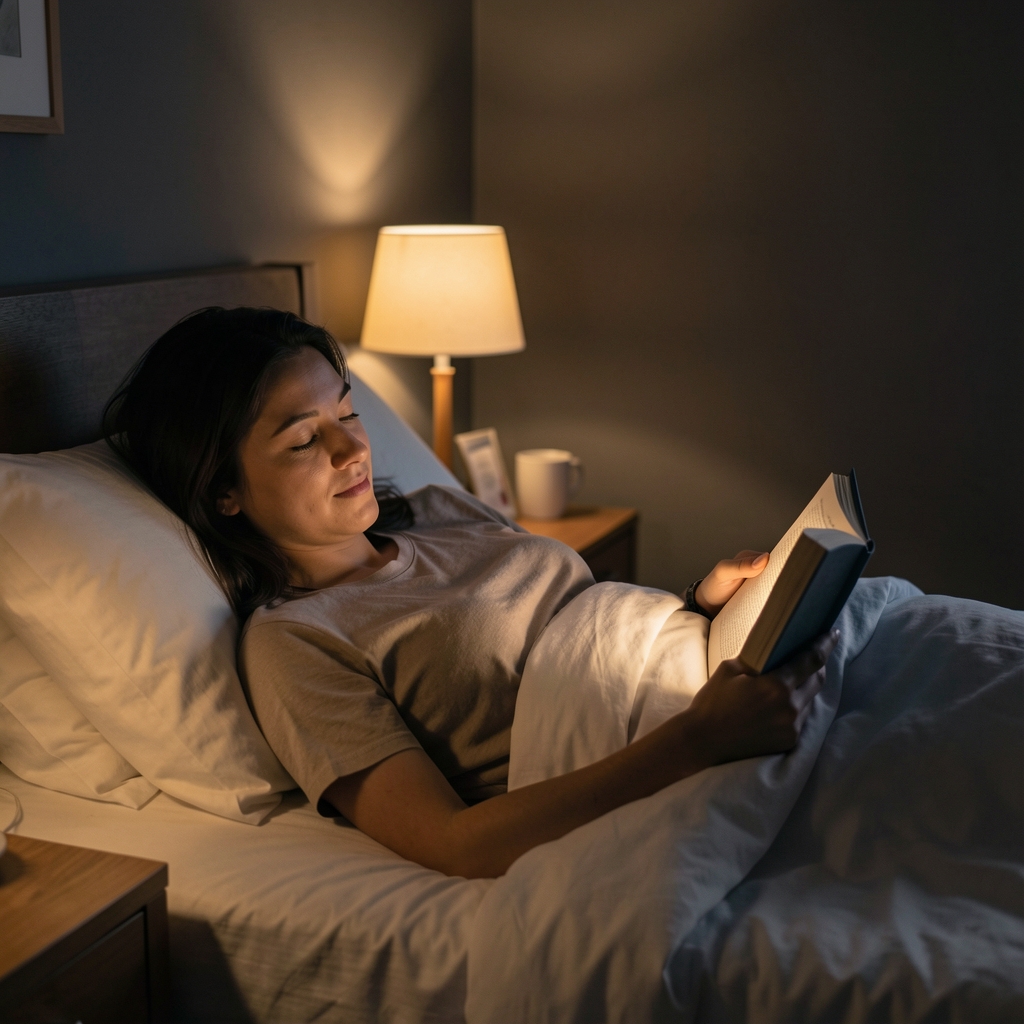
The practical question — what does one actually do with this information? — has a less dramatic answer than the mechanism might suggest. The contributors who reported the clearest improvements in rest quality were not those who made the most elaborate changes. They were those who made the most consistent ones. Reducing screen brightness from seven in the evening onward. Switching overhead lights to warmer, lower-spectrum alternatives in the hour before bed. Spending twenty minutes reading a physical book rather than a device.
None of these changes requires significant effort or expense. What they require is a degree of advance intention — the decision, made in the afternoon rather than at ten at night, about how the evening will end. The contributors who found the screen-free fortnights easiest were those who had arranged their evening in advance rather than waiting to feel ready to put the screen down.
This observation connects to the broader argument of the Gazette's first issue: that the pre-sleep hour responds more to the quality of its arrangement than to any specific action taken within it. Light management is one of the most direct ways to inform the body that the day is closing. But it functions best as a consistent signal rather than an occasional one. The body's internal clock is a system that learns from repetition. It is, in this sense, a record of habits more than a response to single evenings.
- Blue-spectrum evening light delays the body's preparation for rest by mimicking the daytime signal.
- A delayed sleep onset disproportionately compresses slow-wave rest phases rather than simply shifting all stages forward.
- Contributors on screen-free evenings reported earlier natural drowsiness and more calibrated morning appetite.
- Consistency of the light-reduction habit matters more than the specific method used to achieve it.